
Understanding Binary Multiplication with Examples
Learn how binary multiplication works with clear, step-by-step examples 🖥️. Perfect for students & anyone keen on digital computing basics! 📊
Edited By
Amelia Watson
Binary subtraction is a key operation in digital electronics and computing, where numbers are represented in base-2 instead of the usual decimal system. Unlike decimal subtraction, binary subtraction uses only two digits, 0 and 1, which makes the process distinct but straightforward once the basic rules are understood.
In digital circuits, subtraction often involves handling borrow operations, much like in decimal subtraction but with simpler logic. For example, when subtracting a larger bit from a smaller one, a borrow is taken from the next higher bit. This mechanism is essential for accurate calculations within processors and digital devices.
The binary subtraction method typically follows two main approaches:
Direct subtraction with borrow: Similar to decimal subtraction, this method subtracts each bit directly, borrowing when necessary. For instance, subtracting 1 from 0 at a particular bit requires borrowing a 1 from the next left bit, which effectively 'adds' 2 to the current column.
Two's complement subtraction: This widely used technique converts the number to be subtracted into its two's complement form and then adds it to the minuend. This eliminates the need for manual borrow handling and simplifies the hardware design for arithmetic operations.
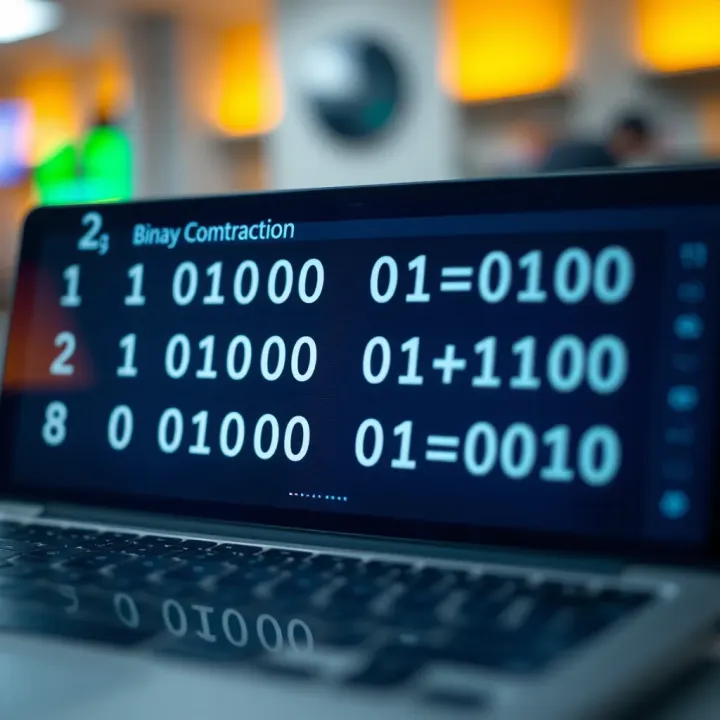
Consider this example of direct subtraction:
1011 (decimal 11)
110 (decimal 6) = 101 (decimal 5)
Here, subtraction is done bit-by-bit from right to left, borrowing when the top bit is smaller than the bottom bit.

Two’s complement subtraction, on the other hand, converts 6 to its two’s complement and adds it to 11. This approach is favoured in most digital systems as it simplifies circuitry and reduces error.

> Understanding how binary subtraction works not only helps in grasping fundamental computing concepts but also has direct applications in financial modelling software, data encryption, and even stock trading algorithms where digital precision is crucial.

Having a clear grasp of these methods can help traders, investors, and analysts who use digital tools to process numerical data accurately and efficiently. In coming sections, we will explore these techniques deeper and see practical examples that make the logic crystal clear.

## Kickoff to Binary Numbers

Understanding binary numbers is central to grasping how digital systems operate. Since computers use only two symbols—0 and 1—to process information, knowing the basics of binary numbers helps you make sense of more complex operations like binary subtraction. This foundation is particularly practical in fields such as finance technology, automated trading systems, and digital data processing where computation speed and accuracy matter.

### Basics of the Binary System

#### Representation of [ones](/articles/binary-addition-multiple-ones-explained/) and zeros

[Binary](/articles/binary-multiplication-explained/) is a base-2 number system, using just two digits: 0 and 1. Each digit is called a 'bit'. For example, the binary number 1011 represents four bits. Each bit corresponds to an on or off state, much like a light switch. In computing hardware, these states physically represent electrical signals: a voltage present (1) or absent (0).

This simplicity allows computers to operate reliably and with less complexity in electronic design compared to decimal or other numbering systems. The clear distinction between the two states reduces errors especially in environments with noise or interference.

#### Significance in digital computing

Binary forms the backbone of all modern computing systems. Every instruction and piece of data—whether a webpage or a financial transaction—is ultimately translated into binary code. This standardisation supports compatibility across different hardware and software platforms.

For instance, stock exchange trading algorithms process massive amounts of real-time data in binary form to execute orders within milliseconds. [Understanding](/articles/understanding-binary-addition-subtraction/) that all such data boils down to zeros and ones helps you appreciate how digital arithmetic, including subtraction, plays a role in these fast-paced environments.

### Difference Between Binary and Decimal Systems

#### Place values in binary

Unlike the decimal system, which uses base 10 with place values like 1, 10, 100, and so on, binary is base 2. Each position represents a power of 2, starting from the rightmost bit as 2^0, then 2^1, 2^2, and so forth.

For example, the binary number 1101 breaks down as:

- 1 × 2^3 = 8
- 1 × 2^2 = 4
- 0 × 2^1 = 0
- 1 × 2^0 = 1

Adding these gives 8 + 4 + 0 + 1 = 13 in decimal. This positional value system is crucial to correctly interpreting and performing arithmetic operations in binary.

#### Conversion examples

Converting between binary and decimal is a key skill. To convert a decimal number like 19 to binary, divide it continuously by 2, noting the remainders:

1. 19 ÷ 2 = 9 remainder 1
2. 9 ÷ 2 = 4 remainder 1
3. 4 ÷ 2 = 2 remainder 0
4. 2 ÷ 2 = 1 remainder 0
5. 1 ÷ 2 = 0 remainder 1

Reading the remainders bottom to top gives binary 10011.

Conversely, translating binary 10110 to decimal involves calculating:

- 1 × 2^4 = 16
- 0 × 2^3 = 0
- 1 × 2^2 = 4
- 1 × 2^1 = 2
- 0 × 2^0 = 0

Adding up to 22 decimal.

> A firm grasp of these conversions helps financial analysts and traders understand how digital systems handle data and calculations behind the scenes, ensuring better trust and insight when relying on automated tools.

Understanding these basics [sets](/articles/binary-relations-in-sets-explained/) the stage for more complex operations like binary subtraction, which underpin all digital calculations in technology-driven finance and beyond.

## Fundamentals of Binary Subtraction

Understanding the fundamentals of binary subtraction is vital for grasping how digital systems perform calculations. Binary subtraction operates on base-2 numbers, crucial to processors and embedded systems in Pakistan’s tech landscape. This fundamental knowledge helps traders and analysts comprehend hardware behaviour in automated trading platforms or financial modelling tools that rely on binary operations.

### How Binary Subtraction Works

**[Simple](/articles/understanding-binary-relations-simple-explained/) subtraction rules** in binary mimic decimal subtraction but involve only two digits, 0 and 1. The basic rules are straightforward:
- 0 minus 0 equals 0
- 1 minus 0 equals 1
- 1 minus 1 equals 0
- 0 minus 1 is not directly possible without borrowing

For example, subtracting binary 1 (01) from 10 (2 in decimal) results in 01 (1 in decimal). These rules simplify calculations but can get tricky when a smaller bit subtracts a larger bit.

**Handling zeros and ones** requires careful attention, particularly when the minuend bit is 0 and the subtrahend bit is 1. Because 0 cannot subtract 1, the system borrows from the next higher bit, similar to decimal subtraction but in binary form. This borrowing resets the borrowed bit and adjusts the current calculation, ensuring correct results. In practice, managing zeros and ones accurately is essential in algorithms embedded in financial calculation software or trading bots that process binary data.

### Borrowing in Binary Subtraction

**What is borrowing?** Borrowing happens when a bit needs to subtract 1 but is 0 itself. Since 0 can’t subtract 1, it borrows a ‘1’ from a higher bit, converting the current bit’s value to 2 in decimal terms (which is 10 in binary). This borrowed value makes the subtraction possible.

**Steps to borrow in binary** are methodical:
1. Identify the nearest higher bit with value 1.
2. Change that higher bit’s 1 to 0 (since it is lending).
3. All bits between that higher bit and the current bit become 1 (if they were 0).
4. The current bit adds 2 (binary 10) for subtraction.

For instance, subtracting 1 from 1000 requires borrowing from the fourth bit, changing it to 0111, then subtracting accordingly. This step-by-step borrowing is fundamental in processor arithmetic units.

**Impact on adjacent bits** is significant since borrowing affects not only the immediate bit but also those in between. When a higher bit lends, intermediate bits may switch to 1 to keep the overall value balanced. This shift can cascade, requiring careful tracking during subtraction. In digital designs and programming, understanding this flow helps prevent errors in binary calculations and ensures systems like embedded controllers operate smoothly.

> Borrowing in binary subtraction is not just a mathematical concept but a cornerstone for digital computation, affecting everything from processor design to financial algorithm accuracy.

This grasp of how subtraction truly works at the binary level equips traders and analysts to better understand the computational processes behind financial technologies. It also underlines why precise handling of zeros, ones, and borrowing is essential for reliable, error-free results in digital operations.

## Methods for Performing Binary Subtraction

Understanding the methods for performing binary subtraction is essential because it caters to different scenarios in digital computing and electronics. Whether working out a simple difference or implementing a complex processor operation, choosing the right method affects both accuracy and efficiency. Practically, these methods help prevent errors like incorrect borrowing and enable implementations in various circuits and software.

### Direct Binary Subtraction

**Step-by-step approach**: Direct subtraction in binary works similarly to decimal subtraction but follows simpler rules due to only two digits—0 and 1. You subtract bit by bit starting from the rightmost bit (least significant bit). When the top bit is less than the bottom bit, you borrow from the next higher bit, just like in decimal arithmetic. This method demands careful handling of borrowing, which influences the adjacent bits and changes the subtraction flow.

**Example calculations**: Suppose you want to subtract binary 1011 (decimal 11) minus 0101 (decimal 5). Start with the rightmost bit: 1 minus 1 equals 0, next 1 minus 0 equals 1, the third bit 0 minus 1 isn’t possible without borrowing, so borrow 1 from the next bit turning 0 into 10 (binary 2), then subtract 10 minus 1 equals 1, and finally 0 (already borrowed) minus 0 equals 0. The result is 0110, or decimal 6. This stepwise approach shows direct subtraction's simplicity, useful in smaller systems or quick calculations.

### Using Two’s Complement for Subtraction

**Concept of two’s complement**: The two’s complement method simplifies subtraction by converting it into an addition problem. Instead of directly subtracting, you take the two’s complement of the subtrahend (the number being subtracted) and add it to the minuend (the number from which you're subtracting). Two’s complement flips all bits and adds one to represent a negative number in binary. This method is widely used in modern processors due to its straightforward implementation.

**Converting subtrahend**: To convert the subtrahend to its two’s complement, invert all bits—changing 0s to 1s and 1s to 0s—and then add 1 to the least significant bit. For example, if subtracting 0011 (decimal 3), flipping yields 1100, adding 1 gives 1101. This step ensures the subtrahend's negative equivalent representation, ready for addition.

**Adding and ignoring carry**: After converting, add the two’s complement of the subtrahend to the minuend. If the result generates a carry beyond the fixed bit length (like a ninth bit in an 8-bit system), ignore that carry. This discarding of overflow reflects the correct subtraction result in the fixed-width binary system. This simplicity makes arithmetic logic units (ALUs) more efficient by avoiding separate subtraction circuits.

**Advantages over direct subtraction**: Using two’s complement avoids complex borrowing steps, which can slow operations and cause errors in direct subtraction. It simplifies hardware design by leaping subtraction into addition circuitry. Additionally, two’s complement handles negative results naturally, allowing seamless operations between positive and negative numbers, crucial for financial computations or signal processing tasks common in Pakistani tech firms dealing with embedded systems.

> In short, direct binary subtraction is straightforward but requires careful borrowing, while two’s complement offers a cleaner, hardware-friendly approach, favoured in most digital systems today.

## Practical Examples of Binary Subtraction

Understanding binary subtraction through practical examples helps demystify the process and shows how it applies in real digital systems. By working through examples, you grasp not just the theory but also the quirks of binary arithmetic, such as borrowing and two's complement, which are fundamental in computing and embedded technology.

### Simple Subtraction Example

Subtracting basic binary numbers involves applying fundamental subtraction rules you already know from decimal arithmetic, such as 1 minus 1 equals 0, and 0 minus 1 requires borrowing. Consider subtracting 1011 (11 in decimal) from 1101 (13 in decimal). Working left to right, you subtract each bit, borrowing from higher order bits when necessary. This reveals how binary subtraction closely mirrors decimal subtraction but with only two digits to manage.

The borrowing step is where many learners pause. When you need to subtract 1 from 0, you borrow a value of 2 from the next left bit, turning the 0 into 10 in binary. Borrowing impacts the adjacent bit by reducing it by one, which may cascade if the adjacent bit is also zero. Understanding this helps when managing binary numbers in programming or hardware design, ensuring accuracy in calculations where manual error is costly.

### Two’s Complement Subtraction Example

The two's complement method simplifies subtraction by converting it into addition. Taking the previous example, instead of directly subtracting 1011 from 1101, you convert 1011 into its two’s complement and add it to 1101. This involves flipping each bit and adding one to the least significant bit, allowing subtraction to be handled easily by digital circuits.

Verification of results ensures the process is accurate. After adding the two’s complement, if there's an extra carry bit beyond the fixed number of bits, it is discarded. The remaining binary number is the correct result. Confirming this step protects against common mistakes in bit-length or overflow—key when building reliable digital systems dealing with fixed-width registers.

> Practical examples like these make binary subtraction tangible, showing you how it happens in everyday digital devices—from calculators to computers—giving you confidence to apply these methods accurately.

## Applications of Binary Subtraction in Technology

Binary subtraction is a fundamental operation deeply embedded in modern technology. It plays a vital role not only in simple calculations but also in complex digital systems. Understanding its applications helps clarify how everyday devices and advanced processors handle numerical data precisely and efficiently.

### Role in Computer Arithmetic

#### Basic calculator operations
Calculators perform subtraction by relying on binary arithmetic behind the scenes. When you enter a subtraction like 15 minus 7 on a digital calculator, it converts these decimal numbers to binary and executes the subtraction using binary subtraction rules. This process is swift and accurate, ensuring that users receive instant results without needing to manage the underlying complexity. The ability to subtract in binary is essential for even simple functions on calculators and digital devices.

#### Processor arithmetic logic units
In computer processors, Arithmetic Logic Units (ALUs) handle all basic arithmetic operations, including subtraction. The ALU uses binary subtraction to manipulate data at the bit level, enabling tasks like address calculations, condition checking, and data processing. For instance, to calculate the difference in memory addresses or perform CPU instruction flow control, the ALU subtracts binary values rapidly. Efficient binary subtraction in ALUs directly affects a processor’s speed and performance, making it a cornerstone of computer architecture.

### Use in Digital Circuit Design

#### Design of subtractor circuits
Digital circuits include dedicated subtractor modules designed to perform binary subtraction between two input values. These subtractors range from half-subtractors—which handle subtraction of single bits—to full subtractors that manage multi-bit operations with borrowing. Engineers design these circuits using logic gates, ensuring reliable and predictable results in hardware. Such subtractor circuits are common in devices like digital clocks, counters, and calculators where direct binary subtraction hardware reduces processing delays.

#### Use in microcontrollers and embedded systems
Microcontrollers, used widely in consumer electronics, automotive controls, and industrial machines, contain built-in arithmetic units that depend on binary subtraction for their operations. For example, embedded systems measuring sensor data often subtract calibration values or previous readings in binary format to derive meaningful information. This subtraction enables tasks such as error correction, signal processing, and system monitoring. Without efficient binary subtraction, embedded systems would struggle to perform real-time computations critical for device responsiveness and reliability.

> Accurate and fast binary subtraction forms the backbone of processing logic in nearly every digital system, making it a crucial concept beyond academic study and into practical, real-world technology.Learn how binary multiplication works with clear, step-by-step examples 🖥️. Perfect for students & anyone keen on digital computing basics! 📊
Explore binary relations in sets 📚 Understand their definitions, properties, types, and real-world applications in math and computer science clearly.

Explore how hydrogen forms binary compounds, their types, properties, and uses in chemistry and industry. Learn key facts about hydrogen's role 🔬⚛️

Learn how binary addition & subtraction work with simple examples and tips 🧮. Understand the basics of binary math for computers and electronics 💻.
Based on 15 reviews