
Understanding Binary Fission with Examples
Explore how binary fission works in organisms, its role in biology, and real-life examples that show this quick reproduction method in action 🧬🔬.
Edited By
Benjamin Carter
Binary fission might sound like one of those scientific terms thrown around in biology class, but it's something that touches the basics of life itself. For traders and investors who often think about growth and reproduction in markets, understanding the growth process in living organisms can offer an interesting analogy—and more.
In simple terms, binary fission is the way many single-celled organisms multiply. It's a form of asexual reproduction where one cell splits into two identical daughter cells. This process keeps populations growing and surviving in various environments.
Why does this matter? Well, for anyone working in finance or education, grasping how nature ensures continuity and adapts over time offers insights into resilience and growth, whether in ecosystems or economies.
In this article, we will explore what binary fission actually means, walk through its step-by-step process, discuss the types of organisms that use it, and examine why it’s important biologically and practically. This understanding can be a small window into how life manages reproduction and growth at its most basic level.
Binary fission is a straightforward yet fundamental process that plays a huge role in how certain organisms reproduce and grow. It's one of the quickest ways a single cell can become two, doubling its numbers without the complications of mixing genetic material from two parents. This kind of reproduction is crucial for bacteria and other microorganisms, helping them multiply rapidly in favorable conditions. For traders and investors keeping an eye on biotech or pharma stocks, understanding binary fission gives insight into how fast bacterial cultures can expand, which impacts antibiotic production and microbial research.
Binary fission is a type of asexual reproduction where one organism splits into two identical copies. It’s like photocopying a single page — every detail is duplicated exactly. This process is the primary way many simple organisms, like bacteria, reproduce. Because there’s no exchange or mixing of genetic material, the offspring are clones of the parent cell. This simplicity makes it fast and efficient, allowing populations to swell quickly when conditions are right.
Key characteristics of binary fission include its straightforwardness and speed. There isn’t any messy reshuffling of chromosomes like in sexual reproduction, which means less time and energy are needed to produce an offspring. This simplicity also means fewer things can go wrong during reproduction, although it does limit genetic diversity. Still, in stable environments, this method works perfectly to keep the population going strong.
Common bacteria and archaea — These tiny creatures rely heavily on binary fission. For example, Escherichia coli, a well-known gut bacterium, can divide every 20 minutes under optimal conditions. Archaea, often found in extreme environments like hot springs or salty lakes, use binary fission too, thriving where other forms of life struggle.
Some protozoa and unicellular eukaryotes — Not just bacteria and archaea pull this off. Certain single-celled eukaryotes, like the protozoan Amoeba, also reproduce through binary fission. These organisms are a bit more complex but still use the simplicity of splitting one cell into two to multiply.
Examples from everyday life — Binary fission isn’t just a lab concept; it affects daily life. When you notice mold growing on old bread or feel sick from a bacterial infection like strep throat, binary fission is at work. It’s also behind the fermentation of foods like yogurt, where bacteria multiply rapidly to transform milk into a tasty product.
Understanding binary fission helps us grasp how quickly microorganisms can proliferate. This knowledge is vital for anyone interested in health, biotechnology, or microbial behaviors in natural or commercial settings.
By knowing which organisms use binary fission and how it happens, you get a clearer picture of microbial growth patterns. Whether you're assessing the risks of bacterial outbreaks or exploring biotechnological innovations, this fundamental process is at the heart of microbial life and its impact on our world.
Understanding the detailed steps of binary fission is vital because it lays the foundation for grasping how single-celled organisms reproduce so quickly and efficiently. This process is the backbone of bacterial propagation, influencing everything from infection spread to biotechnology applications. Knowing each phase helps us appreciate the precision and simplicity behind this overwhelming power of nature.
Before the cell divides, it must copy its DNA to ensure both daughter cells have the genetic blueprint they need. This replication is highly accurate but fast, enabling bacteria like Escherichia coli to multiply in as little as 20 minutes under ideal conditions. The process starts at a specific point on the DNA called the origin of replication and proceeds in both directions until the entire molecule is duplicated. This step is crucial because any errors can lead to mutations, which may be harmful or occasionally beneficial for survival.
While the DNA replication happens, the cell itself grows larger to accommodate two complete sets of cellular machinery. This includes synthesizing new proteins and cellular components, ensuring the cell’s cytoplasm can be divided adequately. Think of it as a balloon inflating while the DNA copies itself, making room for everything. Without sufficient growth, the division might yield one or two weak daughter cells.
Once DNA replication finishes, the two copies must be separated and pulled to opposite ends of the cell. This segregation prevents genetic material from clumping in one half, which would cause unequal distribution. Protein complexes aid this movement, acting like tiny tugboats dragging each DNA strand along the inner membrane, ensuring that each future cell gets the right genetic package.
Next, the cell begins building a new wall, called the septum, right in the middle, where the division will happen. This involves assembling a ring of proteins, including FtsZ, which contracts like a muscle around the center of the cell. This process is like cinching a belt around a bag’s waist — it tightens until the cell is pinched into two.
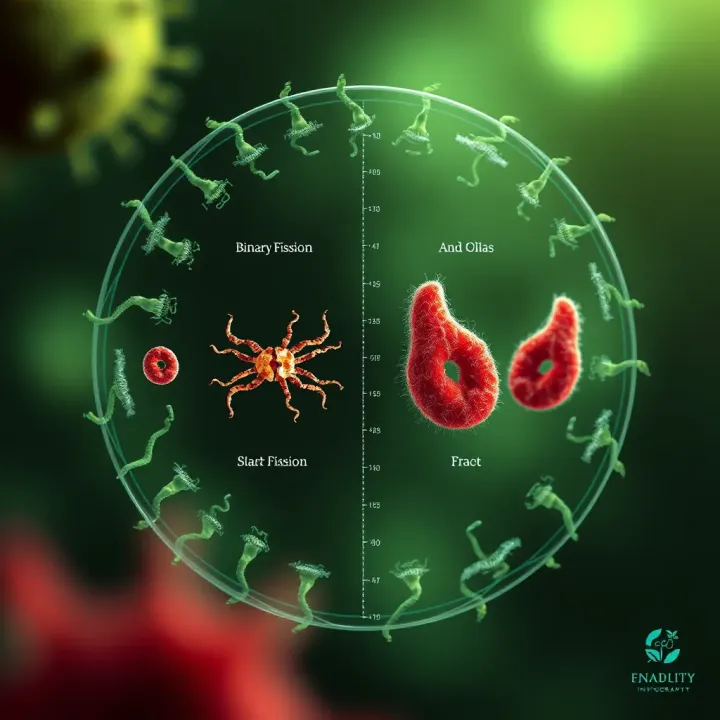
Finally, the septum completes its formation, literally cutting the cell in half and producing two genetically identical daughter cells. Each cell contains the replicated DNA and enough cytoplasmic material to survive and function independently. This step marks the end of binary fission but the beginning of two new cells, ready to grow and eventually divide again.
Binary fission’s detailed steps highlight how life balances speed with accuracy, ensuring survival through precise cellular choreography.
For traders, investors, and analysts watching microbial growth in industries like pharmaceuticals or food production, understanding these details clarifies how bacterial populations expand, potentially impacting supply chains or product quality. Educators can use these insights to explain core biological principles with real-world applications, making the process tangible and memorable.
In summary, detailed knowledge of each phase in binary fission—from DNA replication through to cell splitting—provides clarity on how simple organisms manage complex tasks efficiently, informing both science and industry.
Understanding the different types of binary fission sheds light on how a wide variety of single-celled organisms reproduce. While the core idea—splitting into two cells—remains consistent, the mechanics and nuances differ significantly across organisms. This diversity isn't just a biological curiosity; it impacts how species adapt, survive, and sometimes how we handle infections or use microbes in biotechnology.
Basic symmetrical division: This is the most straightforward form of binary fission. The cell duplicates its genetic material and evenly splits into two mirror-image daughter cells. Both resulting cells typically share equal cytoplasm and genetic information, making this process very efficient for rapid population growth. This symmetry ensures that both offspring are nearly identical, which is helpful for stability and quick adaptation in steady environments.
Examples in common bacteria: Common examples include Escherichia coli and Bacillus subtilis, which reproduce by simple binary fission. In everyday life, this means bacteria found in the gut or soil double at astonishing rates under favorable conditions, sometimes doubling every 20 minutes. This rapid growth explains why bacterial infections can escalate quickly and why food spoilage can occur so fast without refrigeration.
Budding and its distinctions: Unlike simple binary fission, budding produces a new organism from an outgrowth or bud on the parent. Rather than splitting equally, the bud grows on the parent cell and eventually detaches. This process is common in some yeast species like Saccharomyces cerevisiae. Budding allows for quicker reproduction in certain situations while keeping the parent alive longer, often making it advantageous in fluctuating environments.
Multiple fission overview: In this variant, a single cell divides into more than two daughter cells at once. It first makes multiple copies of its DNA, then partitions itself into several offspring simultaneously. This method is seen in some protozoa like Plasmodium, the malaria parasite. The rapid generation of many daughter cells at once can drastically increase populations and explains why certain infections spread uncontrollably if unchecked.
Knowing these variations helps researchers and healthcare professionals tailor approaches to treat infections or utilize microbes in industrial processes more effectively.
In summary, the type of binary fission employed influences not only organism reproduction but also how they respond to environmental challenges and human interventions. Recognizing these distinctions equips traders, analysts, and educators with a better grasp of microbiology's practical and economic ramifications.
Understanding how binary fission stacks up against other reproductive methods is key for grasping its role in biology. It offers a straightforward and quick way for organisms, especially single-celled ones, to multiply. Unlike sexual reproduction or mitosis, binary fission focuses on speed and simplicity, which is crucial in many natural and applied contexts, like bacterial growth in infections or fermentation processes.
Knowing the differences helps pinpoint where binary fission fits in ecological and industrial systems, shedding light on why some organisms rely on it exclusively.
Binary fission is essentially the "cut and copy" method found mostly in prokaryotes like bacteria and archaea. It’s a straightforward split where one cell divides into two identical cells without the complex steps seen in mitosis. Mitosis, on the other hand, takes place in eukaryotic cells, including plants and animals, and involves multiple stages like prophase, metaphase, anaphase, and telophase that carefully divide chromosomes.
Why does this matter? For one, the simplicity of binary fission allows rapid population increases, particularly when conditions are favorable. For instance, Escherichia coli can double every 20 minutes through binary fission, which is much faster than most cells undergoing mitosis.
The end goal of binary fission is to swiftly produce two identical offspring, maintaining genetic consistency—important when the environment is stable. Mitosis also produces identical daughter cells but is mainly about growth and tissue repair in multicellular organisms.
In practical terms, binary fission helps bacteria quickly colonize environments—think about how fast food can spoil due to bacterial growth. Mitosis is more about maintaining the body’s own cells and letting organisms grow or heal after injury.
This is where things get quite different. Sexual reproduction mixes genetic material from two parents, resulting in genetically diverse offspring. This diversity is a survival asset, helping populations adapt to changing environments or fight off diseases.
Binary fission offers very little genetic variation since offspring are clones of the parent. Occasionally, bacterial mutations or horizontal gene transfer can shake things up, but generally, the lack of diversity is a trade-off for how fast organisms can multiply.
Here binary fission shines. It’s fast and doesn’t require a mate, making it wildly efficient in favorable conditions. Take Staphylococcus aureus for example—it can quickly build up its population in wounds, sometimes outpacing the immune response.
Sexual reproduction, by contrast, takes more time and energy, requiring two individuals to reproduce and often involving complex mating behaviors. This complexity means it's slower but pays off in adaptability.
In summary, comparing binary fission with mitosis and sexual reproduction helps us understand why certain organisms stick to a particular method. Binary fission suits those looking to multiply quickly without fuss, while mitosis and sexual reproduction serve other roles in growth, repair, and survival across eukaryotes.
Binary fission stands as a fundamental process powering life at its most basic level, especially in single-celled organisms like bacteria. This mechanism isn’t just about making more cells—it’s about how these organisms thrive, adapt, and maintain their populations. Understanding this helps us grasp everything from the speed of bacterial infections spreading to the basics of biotechnology.
Binary fission allows organisms to multiply incredibly fast. Take Escherichia coli, a common gut bacterium—under ideal conditions, it can split every 20 minutes or so. This quick reproduction translates to explosive population growth, a major reason why bacteria can colonize new environments rapidly. For traders and bioscience professionals, this means bacterial cultures used in labs or industries can be expanded efficiently and predictably, which is critical for scaling up production processes.
Rapid cell division also means a species can bounce back quickly after environmental shifts. If conditions change—like a sudden temperature rise or exposure to antibiotics—having a large, fast-growing population increases the odds some individuals will have slight advantages to survive. This adaptability plays a big role in microbial resilience. Understanding this helps investors and financial analysts in biotech firms predict timelines for product development or outbreak management.
Binary fission typically produces genetically identical daughter cells, preserving the traits that helped the parent cell survive. This genetic stability is crucial, especially in stable environments where consistency pays off. For example, in probiotic manufacturing, reliable replication through binary fission ensures that the bacteria behave as expected, maintaining product quality and consumer trust.
Though offspring are mostly clones, occasional mutations can sneak in during DNA replication. These changes can lead to new traits, some potentially advantageous, driving evolution over time. In a practical sense, this is a double-edged sword. While it can lead to antibiotic resistance—something healthcare professionals closely monitor—it also offers raw material for developing new strains in industrial microbiology. This dynamic highlights the delicate balance between genetic stability and diversity, important knowledge for educators explaining evolution or for investors assessing biotech innovation risks and rewards.
Binary fission isn’t just cell division; it’s nature's rapid-fire method to multiply, adapt, and evolve microbial life. This knowledge arms stakeholders across health, industry, and education sectors with insights into managing and leveraging microbial populations effectively.
Binary fission is not just some abstract biological concept; it has real-world impacts that ripple through medicine, industry, and environmental science. Understanding how bacteria and other microorganisms reproduce quickly helps us harness their abilities or manage their threats. This section digs into two main areas where binary fission matters practically: industrial microbiology and medical science.
Many industrial processes rely on microorganisms reproducing swiftly and reliably. Binary fission enables bacteria like Lactobacillus to multiply rapidly during fermentation, essential in making yogurt, cheese, and other dairy products. This fast reproduction speeds up production cycles and boosts yield without needing complex setups. In biotechnology, genetically engineered bacteria reproduce through binary fission to produce useful compounds, like biofuels or vitamins, making the process cost-effective.
Bacteria that undergo binary fission are crucial players in manufacturing antibiotics. For example, Streptomyces species reproduce by binary fission and produce antibiotics like streptomycin, which fight infections. Similarly, enzymes used in detergents, food processing, and textiles often come from bacteria or fungi that depend on binary fission for population growth. Efficient reproduction ensures enough biomass to extract the desired products economically.
Knowing how bacteria reproduce helps in predicting how infections spread inside the body. Since binary fission allows bacterial populations to double rapidly—sometimes every 20 minutes—an infection can escalate before symptoms appear. This understanding assists healthcare providers in choosing the right timing and type of intervention. For example, Escherichia coli can cause urinary tract infections due to its fast reproduction, making timely antibiotic treatment crucial.
Binary fission also impacts how bacteria develop resistance to antibiotics. When bacteria split, mutations can occur; some mutations might help them survive an antibiotic attack. This is why incomplete or improper antibiotic courses can lead to resistant strains—bacteria multiply before the medication fully clears the infection. Awareness of this process stresses the importance of following prescribed treatments carefully and motivates ongoing research for drugs that can interrupt bacterial reproduction effectively.
The quick reproduction speed of bacteria via binary fission is a double-edged sword—it fuels industrial innovation but also poses challenges in treating infections effectively.
Understanding these practical uses and challenges of binary fission clarifies why it's a concept worth knowing, not only in classrooms but in industries and clinics worldwide.
Explore how binary fission works in organisms, its role in biology, and real-life examples that show this quick reproduction method in action 🧬🔬.

Learn the simple rules and steps for binary multiplication 🧮, including handling carries and real-world uses, perfect for students and pros in Pakistan.

🔢 Master binary addition with clear examples and step-by-step guidance. Understand carry over techniques and its role in modern computing systems in Pakistan.

Explore the basics and types of binary relations 🔄 in math, including reflexive, symmetric, transitive properties, examples, and practical uses across fields.
Based on 11 reviews