

Binary Search Tree Traversal Methods Explained
Explore Binary Search Tree traversal methods 🚀 including Inorder, Preorder, Postorder & Level-order. Learn how to sort, search & manipulate trees efficiently in your code.
Edited By
Daniel Foster
Binary trees are fundamental structures in computer science, widely used in programming and data organisation. To navigate these trees and process their data efficiently, various traversal methods are employed. Understanding binary tree traversal is crucial for programmers, educators, and analysts working on algorithms, especially when manipulating hierarchical data.
Traversal methods define the order in which nodes of a binary tree are visited. They influence how algorithms retrieve, update, or analyse data stored within these trees. In Pakistan's growing tech ecosystem, from university-level computer science classes to coding tasks in software development companies, a solid grasp of these techniques helps streamline problem-solving.
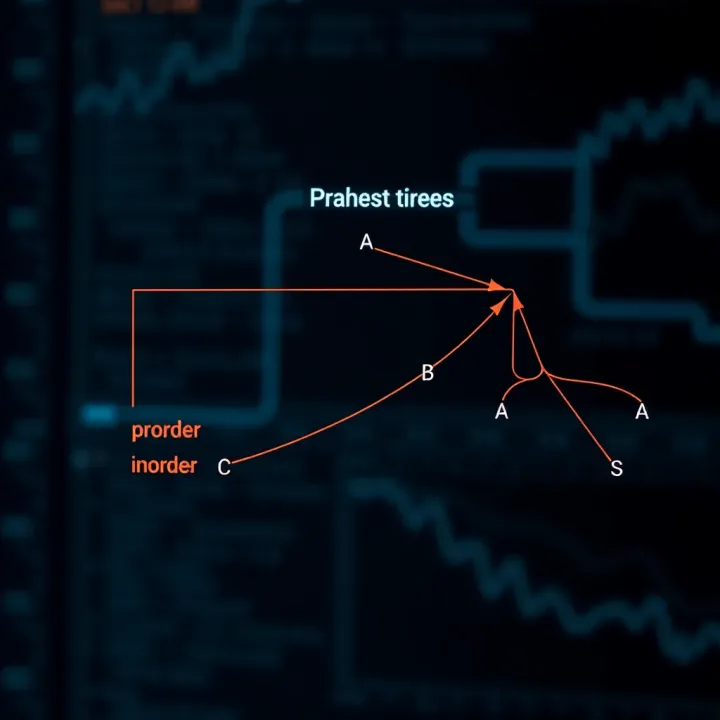
There are three primary depth-first traversal orders:
Inorder traversal visits the left subtree, then the root node, followed by the right subtree. This method is useful for retrieving data in sorted order from binary search trees.
Preorder traversal processes the root node first, then traverses the left and right subtrees. Preorder is ideal when one needs to copy trees or create prefix expressions.
Postorder traversal visits the left and right subtrees before the root node. It’s often used in deleting trees or evaluating postfix expressions.
Besides depth-first approaches, breadth-first traversal (or level-order traversal) visits nodes level by level from the root downwards. This is handy for applications like network broadcasting, scheduling, and shortest path calculations.
Both recursive and iterative implementations of these traversals exist. Recursive methods use function call stacks naturally, making code concise. Iterative methods, often employing explicit stacks or queues, save stack space and are preferred in systems sensitive to recursion limits.
A clear understanding of traversal methods not only aids in solving algorithmic challenges efficiently but also strengthens the foundation for advanced topics like tree balancing, expression parsing, and database indexing.
In the upcoming sections, we will explore each traversal in detail, discuss their practical applications, and provide code examples that resonate with local programming practices.
This foundation prepares you to manipulate binary trees confidently, whether you’re coding a trading algorithm, analysing financial data, or teaching algorithm courses in Pakistan.
Understanding binary tree traversal is key to working effectively with tree data structures in programming and algorithm development. Traversal methods provide systematic ways to visit each node, enabling tasks like searching, sorting, or modifying data stored in a tree.
A binary tree is a data structure composed of nodes, where each node contains data and pointers to at most two children: left and right. This structure allows for efficient hierarchical organisation of information. For example, in a stock trading application, a binary tree could organise price thresholds to decide buying or selling actions swiftly.
Each node in a binary tree has up to two child links: the left child points to a subtree containing values less than the node's data (in some cases), while the right child points to greater or equal values. The topmost node is called the root. This layout makes binary trees especially useful for quick data access and manipulation.
Binary trees exhibit properties that influence traversal approaches. Typical traits include whether the tree is complete (all levels fully filled except possibly the last), balanced (left and right subtrees differ minimally in height), or full (every node has zero or two children). These properties impact how traversal performs in terms of speed and memory.
Traversal is necessary because it defines the order in which nodes are accessed. Without a clear traversal method, it would be difficult to process tree data logically. For instance, if you want to print all values stored in the tree or find a particular element, traversal provides a systematic way to do so.
Tree traversal finds application in several areas relevant to traders and analysts. In searching, it helps locate specific data points quickly, such as stock prices or portfolio elements. Sorting uses in-order traversal to retrieve data in ascending order, useful for reports or decision-making. Manipulating data—like updating or deleting nodes—depends on post-order traversal to avoid disrupting the tree's structure prematurely.
Traversal techniques give a clear, efficient approach to handle complex hierarchies. Mastering them helps in writing better code for data-heavy financial and technical applications.
By understanding how binary trees and their traversals work, users gain a practical foundation to design algorithms that handle data optimally. This makes analysing market data or running simulations considerably easier and faster.
Binary tree traversal methods define how each node in the tree is visited, one by one. Understanding these types is essential because the order of visiting nodes affects how data is processed or extracted from the tree. Each technique serves a distinct purpose and fits different programming tasks. For instance, some traversals make it easier to print values in sorted order, while others help evaluate expressions or manage memory efficiently.
Traversal procedure: In pre-order traversal, the process starts at the root node, then moves to the left child, followed by the right child. This means we visit the current node before its subtrees. The typical sequence is Root → Left → Right. This method reflects a top-down approach, capturing the structure of the tree early on.
Use cases: Pre-order is useful when you want to replicate the tree structure, such as saving a tree to a file or copying it. In compilers, it helps generate prefix expressions (Polish notation) for arithmetic operations. It also works well when you need to process parent's data before dealing with children, like in decision-making trees.
Example with step-by-step explanation: Consider a tree with root 10, left child 5, and right child 20. Pre-order visits 10 first, then 5, and finally 20. This helps you map out the structure clearly, as you access the parent node before moving down. Such clarity supports recursive algorithms that build or analyse trees.
Traversal procedure: In-order traversal visits the left subtree first, then the root node, and finally the right subtree (Left → Root → Right). This approach is especially meaningful for binary search trees (BSTs), where smaller values are on the left and larger on the right.
How it relates to sorted output in binary search trees: Because in-order visits nodes in sorted order, it becomes an efficient way to print all elements ascendingly. For a BST containing values like 5, 10, and 20, in-order traversal outputs 5, 10, 20. This behaviour is vital in many applications requiring ordered data without extra sorting steps.
Practical examples: Print functions in database indexing or file system trees often use in-order to maintain order. If you're scanning data in ascending order or performing range queries, in-order traversal efficiently supports these operations without additional overhead.
Traversal procedure: Post-order traversal visits the left child, then the right child, followed by the node itself (Left → Right → Root). This bottom-up method means the children are dealt with before their parent.
Use in deleting tree nodes and expression evaluation: When deleting nodes in a tree, post-order ensures children remove first, preventing orphaned nodes. Similarly, in expression trees, post-order traversal calculates operands before operators, which matches evaluation order for postfix expressions.
Example walkthrough: Suppose you have an expression tree representing (3 + 5) * 2. Post-order visits 3, then 5, adds them, then visits 2, and finally multiplies the results. This sequence directly supports stack-based evaluation in calculators or interpreters.

How breadth-first search works for trees: Level-order traversal visits nodes level by level, starting with the root. It uses breadth-first search (BFS) logic, moving horizontally across the tree before descending to the next level.
Implementation details: This method typically requires a queue to store nodes of the current level while processing them. Unlike other methods, which use recursion or stacks, level-order navigates the tree iteratively, ensuring all nodes at one depth are handled first.
Applications and sample scenarios: Level-order traversal is helpful in network routing to find shortest paths, or in peer-to-peer systems where information propagates level-wise. In user interfaces, breadth-first display of menus or options offers a natural, easy-to-understand flow. In organisational charts, level-order traversal reflects hierarchy clearly.
Choosing the right binary tree traversal depends on your task—whether you need sorted data, expression evaluation, or level-wise processing. Each method gives you a unique view of the tree structure, helping you solve different programming and algorithmic challenges effectively.
Implementing tree traversal techniques is fundamental to applying binary trees in real-world programming scenarios. Traversals allow you to visit every node systematically, enabling tasks like searching, sorting, and modifying data structures. Whether you're writing code for database indexing or balancing investment portfolios using decision trees, knowing how to implement traversals efficiently helps save time and resources.
Different traversal methods suit different applications. For instance, recursive traversal fits nicely with the tree's hierarchical nature, while iterative methods provide greater control over memory and can prevent stack overflow issues common in deep recursion. Understanding both approaches equips you to choose the best fit for your specific problem.
Recursion naturally matches the branching structure of binary trees. Since each node leads to smaller subtrees, recursive calls can process these subtrees independently. This leads to clean, straightforward code where each function handles one node and then invokes itself on child nodes. Such an approach reflects the mathematical definition of trees, making the logic easier to follow and debug. In Pakistan, where learning resources may focus on conceptual clarity, recursive methods often help beginners grasp tree mechanics effectively.
When implementing recursive traversals, small, clear code blocks can cover pre-order, in-order, and post-order traversals. For example, a simple pre-order traversal would process the root first, then recurse left, then right. These code snippets not only simplify the implementation but also reduce bugs since they rely on a clear, repeatable pattern. This fits well in projects where quick prototyping is needed, such as when writing algorithms for stock market prediction models or portfolio simulations.
For larger or more complex trees, recursion can hit stack limits. Iterative methods solve this by replacing recursion with explicit data structures like stacks. For pre-order, in-order, and post-order traversals, stacks simulate the call stack that recursion uses internally. Using a stack provides direct control over the traversal order and is essential in resource-constrained environments such as embedded devices used in trading terminals.
Level-order traversal is slightly different and employs a queue instead of a stack. This queue supports breadth-first traversal, visiting nodes level by level. In financial analytics tools where tree depth may grow extensively, the queue ensures smooth processing without exhausting memory with deep recursive calls.
Iterative methods come with trade-offs. They often require more code and careful handling of data structures but reduce the risk of stack overflow. They also allow better tweaking of traversal for custom requirements, such as skipping certain nodes or early termination. Although iterative code may seem complex initially, it proves valuable in large-scale applications, including risk analysis systems that operate on massive decision trees where performance and stability are priorities.
Recursive and iterative traversal methods complement each other. Knowing both helps you pick the right approach based on task size, environment limitations, and performance needs.
In summary, mastering both recursive and iterative traversal implementations makes your programming toolkit versatile for tackling a range of binary tree problems common in Pakistan's growing tech and finance sectors. Whether you're creating a trading algorithm or managing a database, the right traversal method ensures efficient and reliable tree manipulation.
Comparing binary tree traversal techniques is key to picking the right method for your specific task. Different traversal orders lead to different sequences of nodes visited, affecting how data is processed or represented. For example, while in-order traversal gives a sorted order in binary search trees, pre-order traversal can reconstruct the tree structure quickly. Weighing these differences helps in choosing the approach that best fits memory limits, execution speed, and problem requirements.
The order in which nodes are visited fundamentally changes the output. In pre-order traversal, the root node is processed first, which is great for copying a tree or serialising data. Meanwhile, in-order traversal visits the left subtree, then the root, then the right subtree; this order lends itself naturally to printing sorted data in binary search trees. Post-order traversal waits until a node’s children are handled before processing the node itself, making it useful for safely deleting nodes or evaluating expressions.
This sequence matters in practical terms. Say you want to calculate a mathematical expression stored in a tree—the post-order traversal ensures operands are handled before operators, preventing errors. On the other hand, if you want to list all files in a directory (modelled as a tree) before opening them, pre-order might be your pick because it processes the folder before its contents.
Understanding which traversal fits your problem saves time and resources. If your goal is to retrieve data in sorted order from a binary search tree, in-order traversal is the natural choice. For tasks like tree reconstruction or cloning, pre-order traversal works well because it captures the root node before its children.
For cleanup operations, such as freeing memory in programming languages without garbage collection, post-order traversal is effective since it processes child nodes before the parent, avoiding orphaned nodes. Level-order traversal, or breadth-first traversal, is handy when you want to process nodes level by level, such as in networking where you might want to broadcast messages starting from the root node to immediate neighbours and so forth.
Time complexity for all standard binary tree traversals—pre-order, in-order, post-order, and level-order—is generally O(n), with n being the number of nodes. Each node is visited once, so the core difference lies not in how long traversing takes, but in auxiliary data structures used and memory management.
Recursive traversals like pre-, in-, and post-order use the call stack, which can lead to stack overflow with very deep trees common in some financial computing tasks. Iterative solutions employing stacks or queues can control memory better but need extra coding effort. Level-order traversal naturally requires a queue to hold nodes on the current level, which could use more memory when trees are wide but shallow.
Different traversal methods bring trade-offs in memory and processing order but all aim to visit every node efficiently. Choosing the right one depends on balancing your application’s data needs, memory constraints, and expected tree structure.
To sum up, knowing these differences equips you to tackle problems more effectively, whether you’re navigating complex decision trees in market analytics or parsing abstract syntax trees in compiler design.
Binary tree traversal methods are not just academic concepts—they have real-world applications that make operations on data structures efficient and meaningful. By understanding how these traversals work, you can better organise data, evaluate expressions, and handle complex decision-making processes in programming and business logic.
Traversals play a vital role in binary search trees (BSTs), where the in-order traversal visits nodes in ascending order. This property makes it simple to retrieve sorted data from the tree efficiently. For example, when dealing with stock price records or trade transactions stored in a BST, an in-order traversal can generate a sorted list swiftly, aiding in analysis.
Besides organising retrieval, traversals like pre-order or post-order assist in searching specific nodes by following a systematic path through the tree. This is especially useful when filtering investment portfolios based on criteria that map onto the binary tree's structure.
In data organisation tasks, traversals help balance the tree and manage insertions or deletions to keep the dataset optimised. For instance, a broker managing a ledger of client orders can use traversal methods to update and restructure data efficiently, ensuring quick access and minimal processing time.
Efficient tree traversal also supports sorting algorithms integrated with tree structures, improving performance over traditional sorting in certain cases, particularly when data reflects hierarchical relationships.
Post-order traversal is especially valuable in evaluating expression trees, where nodes represent operators and operands. Traversing the tree post-order ensures that computation proceeds bottom-up—first solving sub-expressions before applying operators higher in the tree. This method fits well in financial computations, like calculating complex interest formulas or derivatives within trading algorithms.
Constructing expression trees from mathematical expressions allows computers to parse and calculate results efficiently. For example, a trading software might convert client-defined formulas into expression trees, then use traversals to compute values dynamically.
This technique simplifies debugging and modifying calculations since the tree structure visually represents the operation hierarchy, making it easier to identify errors or optimisation points.
File system navigation often depends on tree traversal techniques. Operating systems use traversals like pre-order or post-order to move through directory structures, finding files or managing storage allocation. In the Pakistani IT sector, administrators rely on such methods for backups and organising large server directories, ensuring data integrity and fast access.
Similarly, network routing algorithms use tree-based models to decide paths based on traversal methods. Decision trees in artificial intelligence and machine learning also apply traversals to assess choices systematically.
For example, an investment firm using decision trees to evaluate risk factors across multiple scenarios will traverse nodes representing conditions, combining outcomes to reach optimal decisions.
Traversing binary trees is more than a programming task; it underpins many critical operations in finance, computing, and data management, making it an essential skill for developers and analysts alike.
Working with binary trees often reveals practical challenges that can disrupt traversal operations. Recognising and addressing these issues early saves time and computing resources, especially when dealing with complex or large-scale data structures. This section focuses on commonly faced problems like handling large trees efficiently and preventing errors such as infinite loops, offering actionable insights for smooth implementation.
Recursion is the standard method for implementing tree traversals due to its natural fit with tree structures. However, with deep or unbalanced binary trees, recursive calls can pile up quickly, potentially causing stack overflow. This happens when the call stack runs out of allocated memory, often crashing the program. For instance, traversing an unbalanced tree with thousands of nodes left-heavy might exhaust stack space on platforms with limited memory settings.
To mitigate this, one can switch to iterative traversal methods that use explicit data structures like stacks or queues instead of relying on the call stack. Iterative approaches give better control over memory usage and reduce the risk of overflow errors. Plus, in environments where resource constraints are a concern—such as embedded systems or older machines—iterative code is more reliable.
Optimising memory use also means managing the auxiliary space during traversal. Recursive traversal inherently uses memory proportional to the tree's height for the call stack. When trees grow large, this can become significant. Iterative methods, if implemented poorly, may also consume more memory, for example, by storing entire levels of the tree unnecessarily. Efficient coding practices include pruning unnecessary storage, reusing variables, and avoiding deep call stacks by balancing the tree where possible.
Though trees, by definition, shouldn’t contain cycles, corrupted or incorrectly constructed structures might lead to cyclic references. Traversing such trees without checking can result in infinite loops that lock up programs. Cycle detection is crucial, especially when trees are built dynamically or sourced from external inputs. Techniques like marking visited nodes or using hash sets to store node references during traversal help detect these cycles and prevent endless processing.
Validating the input tree before traversal is another vital step. It includes checking that each node properly links only to zero, one, or two children, ensuring no nodes point back to ancestors or appear multiple times. Input validation avoids subtle bugs and logically inconsistent states. For instance, when parsing a tree from user input or reading from a file, rigorous checks can catch malformed trees early and prompt errors instead of silent failure.
Detecting and handling tree errors upfront not only protects software from crashes but also reduces debugging time significantly.
Together, these troubleshooting practices enable developers, educators, and analysts to work confidently with binary trees in any application—be it parsing financial data structures, building decision trees, or optimising database queries.
Properly summarising binary tree traversal methods and following best practices can save developers significant time and effort later. This section pulls together the key points from various traversal types and implementation tips, helping you see which method fits best for distinct problems. For instance, knowing when recursive pre-order suits expression evaluation versus iterative in-order for memory-limited devices makes all the difference.
Understanding this summary helps you avoid common mistakes—such as stack overflows during deep recursive traversals or choosing inefficient approaches that waste resources. It is like having a well-planned route before driving through a busy city; the right choice improves both speed and accuracy.
Different traversal methods serve different goals, so matching the traversal to your problem is essential. For example, if you want to print data sorted from a binary search tree (BST), using in-order traversal is the right choice as it naturally visits nodes in ascending order. On the other hand, if you are evaluating an arithmetic expression represented as a binary tree, post-order traversal works well because it processes operands before applying operators.
Practical relevance is high: in software development or algorithm design, choosing the correct traversal simplifies the code and improves efficiency. For tasks such as deleting nodes in a tree safely, post-order traversal avoids dangling references by handling children first. Similarly, level-order traversal comes handy in situations like network broadcast simulation or file system scanning where processing breadth-wise makes sense.
Clean, efficient code matters especially when dealing with large trees common in data structures and financial databases. One key tip is to prefer iterative methods when stack overflow risk poses a threat, like in memory-constrained environments or very deep trees often encountered in big data contexts. Using stacks and queues explicitly provides better control over memory usage.
Additionally, keeping your traversal code modular helps maintenance. For instance, isolating traversal logic in reusable functions allows easy swapping between recursive and iterative versions depending on runtime constraints. Always consider time complexity—each traversal typically takes O(n), but optimising memory usage can greatly impact performance. Small improvements, like avoiding redundant checks or early exits upon search success, add up to noticeable gains in real applications.
Efficient traversal is not only about reaching all nodes, but doing so with minimal time and memory overhead, ensuring smooth operation even under heavy workloads.
By carefully selecting traversal methods and writing efficient code, you position yourself to handle data structures confidently, no matter the scale or complexity.
Explore Binary Search Tree traversal methods 🚀 including Inorder, Preorder, Postorder & Level-order. Learn how to sort, search & manipulate trees efficiently in your code.

🌟 Learn binary search basics and coding examples to quickly find items in sorted lists. Understand its efficiency and practical use, perfect for learners in Pakistan.
Learn to implement a binary tree in C++ with clear source code. Explore node structure, insertion, and traversal methods for efficient programming 📂💻
Discover how to implement Binary Search Trees (BST) in Python with step-by-step code, covering insertion, search, deletion, and performance tips 🇵🇰📚🔍
Based on 15 reviews