

Understanding Binary Signals: A Clear Guide
💡 Explore how binary signals power Pakistan's digital networks, decode their function, tackle challenges & apply insights to enhance communication systems effectively.
Edited By
Amelia Foster
A binary tree is a fundamental data structure widely used in computer science, finance, and data analysis. Its height is a key characteristic that influences how efficient certain algorithms perform, especially those related to searching, sorting, and organisation of data.
The height of a binary tree refers to the number of edges on the longest path from the root node down to the furthest leaf node. In simpler terms, it's the maximum depth of the tree. For example, in a binary tree where the longest path from the root to a leaf takes 4 steps, the height is 4.

Understanding the height is vital because it directly affects the complexity of tree operations; a taller tree often means slower operations.
To give a practical viewpoint, consider a trading application managing a large database of market transactions organised in a binary search tree. The height influences how quickly the software retrieves or updates records. A balanced binary tree with minimal height helps maintain fast search times, whereas an unbalanced tree with excessive height slows down performance.
There are two common ways to determine the binary tree's height:
Recursive Method: This approach calculates the height by checking the height of the left and right subtree for every node and taking the maximum. It naturally fits the tree’s hierarchical structure.
Iterative Method: Utilising queues and level-by-level traversal (like breadth-first search), this method counts the number of levels in the tree.
Both methods offer advantages depending on the application context. For instance, recursive height calculation is elegant and simple but can lead to stack overflow for very deep trees, while iterative methods use more memory but are safer for large datasets.
In summary, grasping the concept of the binary tree’s height helps you appreciate its role in algorithm optimisation and data structure efficiency. This understanding is especially useful for professionals working on financial modelling, data analysis, or any application where quick data access is a priority.
Understanding the height of a binary tree is fundamental when analysing data structures and algorithms. It directly influences the efficiency of tree operations like searching, insertion, and deletion, which traders and financial analysts often encounter when dealing with ordered data or decision trees. For instance, in investing algorithms, a deep tree means more steps to reach a decision, affecting response times impressionably.
Knowing the height helps optimise algorithms that rely on tree traversal, making it easier to forecast computational loads and memory usage. This is especially relevant when handling large datasets or implementing balanced trees where height minimisation is key.
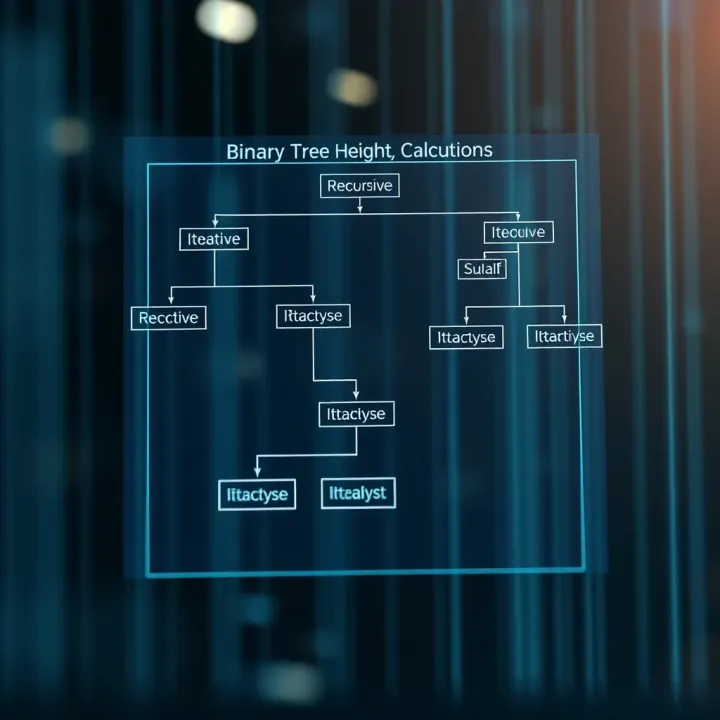
A binary tree is a hierarchical data structure where each node holds a value and can have up to two child nodes, often called the left and right child. This simple structure allows for efficient organisation of data, making binary trees popular for representing sorted collections like those used in stock price indexing.
The structure supports quick searches because each comparison eliminates half of the remaining nodes in an ideal scenario, similar to searching for a particular stock ticker in an ordered list. The practical relevance lies in its ability to model relationships efficiently, such as parent-child links in corporate hierarchies or decision paths in trading strategies.
Types of Binary Trees include several forms, each serving specific practical needs. A full binary tree has every node with zero or two children, often used in scenarios demanding uniformity, such as balanced search trees.
A complete binary tree is filled on all levels except possibly the last, which is filled left to right. This structure is useful for implementing binary heaps in priority queues, critical in scheduling financial transactions.
Other common types include balanced binary trees, which keep height minimal to ensure efficient performance, and degenerate trees, which behave like linked lists, slowing down operations and generally avoided.
Though often confused, height and depth denote different concepts in binary trees. Height is the number of edges on the longest path from a node down to a leaf, while depth is the number of edges from a node up to the tree’s root.
Practically, height measures how tall the tree is, impacting performance of operations that traverse from root to leaves. Depth helps determine a node's level within the tree, useful when analysing the complexity of accessing specific data points like client accounts in a fintech database.
For example, in a tree representing trade orders, a node’s depth tells you how far a particular order is from the origin (root), whereas height shows the maximum steps needed to reach any order.
Consider a binary tree of investment portfolios where the root is the main portfolio and child nodes represent sub-portfolios. The depth of a sub-portfolio indicates how many tiers it is away from the main portfolio, say depth 2 means two levels down.
The height, however, is the longest route from any portfolio to the smallest sub-portfolio. A height of 4 indicates there are portfolios nested four levels deep, a detail important for understanding the maximum complexity when querying portfolio data.
Height of an empty tree is defined as -1 or sometimes 0, depending on the convention followed. This definition matters for coding algorithms, as it sets the base case to terminate recursion effectively.
In practical applications, recognising an empty structure helps prevent errors when parsing data inputs or dealing with uninitialised financial models.
Height of a single-node tree is zero since there are no edges extending beyond that single node. This case is simple yet crucial for understanding the base performance conditions of tree operations.
Most importantly, this definition anchors recursive calculations upwards, enabling consistent height determination even in complex trees modelling market data or organisational charts.
Understanding the height of a binary tree is not just an academic exercise; it directly affects how quickly you can find information, make decisions, and design efficient data-driven systems in trading and finance.
Calculating the height of a binary tree is fundamental for understanding its structure and optimising related algorithms like search and traversal. Knowing the height helps evaluate tree balance, which directly impacts performance in real-world applications such as database indexing or network routing. Commonly used methods include recursive and iterative approaches, each with specific trade-offs around simplicity, resource usage, and execution time.
The recursive method calculates height by diving down the tree branches until it reaches leaf nodes, then working back up. It finds the height of both left and right subtrees of a node, adds one (for the current node), and returns the maximum of these values. This straightforward logic is easy to implement and matches the natural definition of tree height.
This method suits trees where depth isn’t too large, because deep recursion can risk stack overflow. For example, in a binary search tree with moderate height, a simple recursive function in Python or Java efficiently returns the tree height.
python
class Node: def init(self, val): self.val = val self.left = None self.right = None
def height(node): if node is None: return 0 left_height = height(node.left) right_height = height(node.right) return max(left_height, right_height) + 1
Similarly, in Java, the recursion follows the same pattern but with stricter typing and explicit null checks. This method’s clarity benefits educators and programmers dealing with concept demonstrations or moderate-sized trees.

### Iterative Techniques with Level Order Traversal

The iterative approach usually employs a level order traversal, commonly implemented with a queue, to count layers from the root downward. This method uses breadth-first search (BFS) to visit each level one by one, incrementing height after completing each level.

For instance, if you consider a telecom network represented as a binary tree, using BFS helps determine the maximum hops from main server (root) to any device (leaf).

#### Advantages and limitations:

This technique avoids recursion stack overflow and explicitly manages memory, which can be critical for very deep or unbalanced trees. However, it requires [additional](/articles/understanding-binary-addition/) space for the queue and can be slightly slower due to repeated queue operations.

Unlike the recursive approach, it's often more efficient when dealing with large datasets or in languages/environments where recursion depth is limited.

### Comparing Different Approaches

#### Time and space complexity:
Both methods traverse every node once, making their time complexity O(n) where n is the number of nodes. Recursive approach uses call stack depending on tree height (O(h) space), while iterative BFS uses a queue that can hold up to O(width) nodes—worst case, this could be proportional to n.

#### Suitability for various tree sizes:
Recursive methods work well for balanced and small to medium trees often encountered in academic settings or standard applications. Iterative techniques are more practical for very large or skewed trees common in real-world data, like large file directory trees or network topologies.

> Understanding these methods aids in choosing the right tool for computing binary tree height based on tree size, system constraints, and application requirements. For Pakistani tech professionals working on finance or telecom data, this insight ensures stability and efficiency in their software solutions.


## Practical Importance of Knowing Tree Height

Understanding the height of a binary tree is vital for improving a variety of computing tasks. The tree height directly affects how efficiently algorithms traverse or search through nodes. For example, a taller tree usually means more steps are needed to reach certain nodes, which can slow down operations. Knowing the height helps in choosing the right approach for faster execution.

### Optimising Tree Traversal and Search

The height of a binary tree influences algorithm efficiency because traversal methods often depend on the number of levels. If the tree is uneven or tall, recursive or iterative search can take longer, increasing time complexity. On the other hand, shorter, well-structured trees reduce the search path and improve speed.

Binary search trees (BSTs) show this effect clearly. If a BST is unbalanced, with nodes skewed toward one side, its height grows and search times worsen, sometimes matching linear complexity. In contrast, a balanced BST keeps height minimal, allowing searches, insertions, and deletions to perform in roughly logarithmic time. This is critical for databases or trading platforms where response time matters.

### Balancing Trees for Better Performance

Height plays a key role in maintaining balanced trees. Balanced trees limit their height to ensure efficient access to all nodes. This balancing prevents the tree from degenerating into a linked list, which would dramatically slow down data operations.

Common balancing algorithms, such as AVL and Red-Black trees, actively manage height during insertions and deletions. For example, AVL trees rotate nodes to maintain a height difference of at most one between subtrees. This careful adjustment keeps operations like search and update consistently quick, which benefits financial analysis systems that handle large datasets needing frequent updates.

### Applications in Data Storage and Networking

In file system hierarchies, understanding tree height matters because it reflects folder nesting levels. Deeply nested directories may cause delays when accessing files or backing up data. Optimising structure to manage height improves file retrieval speeds and system performance, essential for firms handling vast document storage.

Routing in network topologies also relates closely to tree height. Network nodes arranged with minimal height facilitate faster communication because data packets travel fewer hops. Knowing the height helps network engineers design more effective routing paths, reducing latency in real-time trading platforms or financial data exchanges.

> *Note:* Whether it is software design, file management, or networking, striking the balance between tree height and structure is key to maintaining performance and reliability in critical systems.


## Challenges in Handling Large Binary Trees

Large binary trees present specific challenges that impact both performance and resource management. These issues are particularly relevant when working with extensive datasets or real-time systems, where efficiency and reliability are key. Understanding these challenges helps developers design better algorithms and data structures.

### Memory Constraints and Stack Overflow Risks

Recursive methods to calculate tree height or traverse nodes are common due to their simplicity. However, recursion depends heavily on the call stack, which has a limited size. For deep trees, especially those resembling linked lists (unbalanced with many levels), recursive calls can quickly exhaust the stack memory and lead to stack overflow errors. For example, a binary tree with depth over 10,000 could cause a program crash if recursion is used without precautions.

To avoid these limitations, iterative techniques such as level order traversal (using queues) can replace recursion. These methods handle large trees safely by managing memory within the heap rather than the call stack. Tail recursion optimisation (where available) also helps, but many programming environments in Pakistan, like older Python versions, do not support this efficiently. Using an explicit stack structure or transforming recursive code into iterative loops are practical alternatives that maintain stability when handling big trees.

### Performance Issues with Deep Trees

Deep binary trees can drastically increase time complexity for certain operations. For instance, searching or inserting in an unbalanced tree has time complexity close to O(n), where n is the number of nodes, because the operations might traverse most of the tree path. This leads to slower response times and higher CPU usage — conditions that are detrimental in performance-sensitive applications such as financial trading platforms or real-time analytics.

To counter this, height reduction strategies are used, such as balancing algorithms like AVL trees or Red-Black trees. These algorithms automatically adjust tree structure during insertion or deletion to keep the height near log(n), improving efficiency significantly. Self-balancing trees are widely implemented in databases and systems that require fast lookups and modifications. Another practical approach is to redesign data storage as B-trees or tries for even wider branching, suitable in database indexing used in Pakistani fintech applications.

> Managing large binary trees effectively means balancing between memory constraints and performance requirements. Using iterative approaches and balancing techniques ensures stable and fast operations even with massive data.

In summary, recognising the challenges of deep and large binary trees enables engineers and analysts to select appropriate data structures and algorithms, which is essential for building reliable and efficient systems in real-world environments.

## Parting Words and Further Reading

Wrapping up the discussion on the height of a binary tree, the conclusion section helps clarify the main ideas and practical uses covered so far. It reminds readers why understanding tree height matters in coding, data structures like binary search trees, and real-world applications such as network routing. Further reading guides direct readers to trusted sources for deepening their grasp or tackling complex problems beyond this article’s scope.

### Summary of Key Points

The height of a binary tree measures how many levels it spans from root to the deepest leaf. Calculating height can be done through recursion or level order traversal, each with its pros and cons regarding speed and memory use. Knowing the height is central in optimising search algorithms and ensuring balanced trees, which boosts overall performance. Large trees pose challenges like stack overflow risks during deep recursive calls and slower operations, which can be mitigated by height reduction strategies.

### Recommended Resources for Deepening Understanding

#### Books and Online Courses

For those wanting a solid foundation, textbooks like "Data Structures and Algorithms Made Easy" by Narasimha Karumanchi offer clear explanations with examples on binary trees and their properties. Online courses on platforms like Coursera or Udemy provide practical modules covering tree structures, often with Pakistan-friendly timing options and subtitles. These materials help learners progress from basics to advanced algorithms, which is quite useful for software developers and students preparing for exams like the CSS or technical job interviews.

#### Relevant Programming Tutorials

Hands-on tutorials that walk through coding tree height calculations in languages like Python, Java, or C++ make the theory practical. Websites such as GeeksforGeeks and HackerRank feature problem sets specific to binary trees where you can practice recursive and iterative methods. Working through these exercises helps cement understanding and improves algorithm design skills, essential for everyday programming tasks and financial modelling tools that rely on efficient data structures.

> Developing a strong command of binary tree concepts, especially height, equips you to write better code and understand the limits and optimisation techniques relevant to complex data-driven applications.

This section encourages readers to review the article’s main insights and then explore recommended resources to enhance their skills, especially useful for traders, financial analysts, and educators aiming to incorporate algorithmic thinking in their work.💡 Explore how binary signals power Pakistan's digital networks, decode their function, tackle challenges & apply insights to enhance communication systems effectively.

Explore the basics and types of binary relations 🔄 in math, including reflexive, symmetric, transitive properties, examples, and practical uses across fields.

Learn the simple rules and steps for binary multiplication 🧮, including handling carries and real-world uses, perfect for students and pros in Pakistan.

🔢 Master binary addition with clear examples and step-by-step guidance. Understand carry over techniques and its role in modern computing systems in Pakistan.
Based on 9 reviews